How the Recruitment Process Changed in 2026: The AI Revolution in Hiring
Recruitment in 2026 Looks Nothing Like It Did Three Years Ago
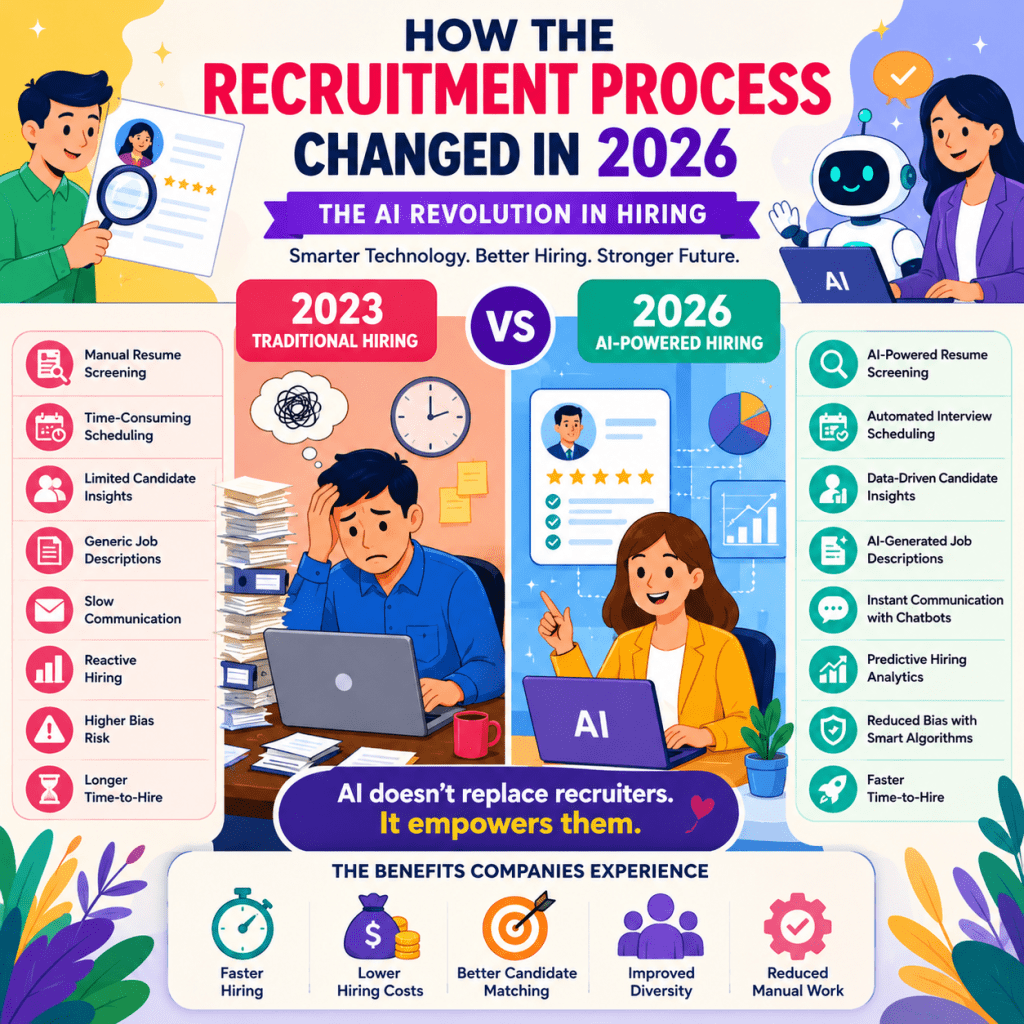
Back in 2023, most hiring teams were still buried under manual work.
Recruiters spent hours screening resumes, scheduling interviews, writing job descriptions, and chasing candidates across multiple platforms. Hiring decisions often moved slowly, and many companies struggled to fill critical roles despite receiving hundreds of applications.
By 2026, the recruitment process changed dramatically.
Artificial intelligence moved from being an experimental HR tool to becoming a core part of enterprise hiring operations. AI recruitment platforms now help companies identify talent faster, automate repetitive tasks, predict hiring success, and improve workforce planning at scale.
The shift did not happen overnight. But once labor shortages, remote work expansion, and skills gaps intensified, businesses accelerated investments in AI hiring systems and recruitment automation.
Now, recruiters are working differently. Candidates are applying differently. And enterprise hiring strategies are becoming far more data-driven than ever before.
AI Resume Screening Became Standard Practice
One of the biggest changes in recruitment came from AI-powered resume screening.
In previous years, recruiters manually reviewed large volumes of applications. That process created delays and often caused qualified candidates to get overlooked.
In 2026, AI systems can analyze thousands of resumes in minutes.
Modern recruiting platforms evaluate experience, skills, certifications, career patterns, and even role compatibility using machine learning models. Instead of searching only for keywords, advanced AI hiring systems now understand context and transferable skills.
A cybersecurity company hiring cloud security engineers, for example, can automatically identify candidates with adjacent infrastructure experience even if their resumes do not exactly match the job title.
This significantly reduced screening time.
Many enterprise organizations reported hiring cycle reductions of 30% to 50% after implementing AI recruitment workflows.
Predictive Hiring Analytics Changed Decision-Making
Recruitment teams are no longer relying only on intuition.
Predictive hiring analytics became a major part of talent acquisition strategies in 2026.
AI platforms now analyze historical hiring data, employee performance trends, retention rates, and productivity patterns to predict which candidates are more likely to succeed in a role.
This shift helped companies move beyond surface-level hiring decisions.
A retail enterprise expanding into new regions, for instance, can now use predictive models to estimate staffing demand months in advance while also identifying which candidate profiles historically stayed longer in customer-facing roles.
That level of forecasting changed workforce planning entirely.
Hiring became less reactive and far more strategic.
AI Interview Assistants Are Now Common
Interview scheduling used to be one of the most frustrating parts of recruitment.
That changed quickly once conversational AI entered hiring workflows.
AI interview assistants now handle interview coordination, reminders, candidate communication, and preliminary assessments automatically.
Some systems even generate interview summaries and skill evaluations after video interviews.
Recruiters are saving hours every week because AI handles administrative work that previously slowed down hiring teams.
Candidates also benefit from faster communication.
One major complaint in recruitment used to be silence after applying for jobs. AI-powered communication systems reduced that problem significantly by keeping applicants informed throughout the process.
Skills-Based Hiring Replaced Degree Obsession
Another major recruitment trend in 2026 is the rise of skills-based hiring.
Companies realized that traditional degree requirements were limiting access to talent.
AI helped accelerate this shift.
Modern AI hiring platforms focus more heavily on demonstrated capabilities, certifications, project experience, and technical assessments rather than academic pedigree alone.
This became especially important in technology, cybersecurity, cloud infrastructure, and AI-related roles where skills evolve faster than university curriculums.
As a result, companies widened their talent pools while improving workforce diversity.
Many organizations also began using AI to identify internal employees who could transition into new roles through reskilling programs instead of hiring externally.
AI-Generated Job Descriptions Improved Hiring Efficiency
Writing job descriptions used to consume significant recruiter time.
In 2026, AI tools can generate optimized job postings within seconds.
Recruiters simply provide role requirements, seniority levels, and hiring objectives. AI platforms then create structured descriptions tailored for candidate engagement, SEO visibility, and inclusivity.
These systems also flag biased or exclusionary language automatically.
That became increasingly important as companies focused more seriously on diversity and equitable hiring practices.
The result is faster campaign launches and more consistent employer branding across hiring channels.
Recruitment Automation Reduced Manual Work
Recruitment automation became one of the most valuable outcomes of AI adoption.
Tasks that once required large recruiting teams are now handled through automated workflows.
This includes:
- Candidate sourcing
- Resume ranking
- Interview scheduling
- Follow-up emails
- Candidate nurturing
- Assessment coordination
- Offer management
Enterprise recruitment teams can now manage significantly larger hiring volumes without dramatically increasing headcount.
That efficiency became critical during periods of aggressive expansion and talent shortages.
Candidate Scoring Systems Became More Sophisticated
AI candidate scoring systems evolved rapidly between 2024 and 2026.
Earlier systems focused too heavily on keyword matching. Modern systems evaluate broader indicators like skill relevance, career progression, adaptability, project complexity, and role alignment.
Some platforms also integrate external data sources such as certifications, portfolios, and verified technical assessments.
Recruiters still make final hiring decisions, but AI now helps prioritize candidates more accurately.
This reduced recruiter fatigue and improved shortlisting consistency across large hiring programs.
Conversational AI and Chatbots Became Frontline Recruiters
Candidates increasingly interact with AI before speaking to human recruiters.
Conversational AI tools now answer questions, guide applicants through processes, recommend jobs, and provide application updates instantly.
For global enterprises hiring across multiple regions, chatbots became especially valuable.
They provide 24/7 support while reducing operational pressure on talent acquisition teams.
A healthcare organization hiring thousands of seasonal workers, for example, can now automate large portions of candidate engagement without sacrificing responsiveness.
Internal Mobility Became AI-Driven
One of the most important changes in 2026 hiring is the focus on internal talent mobility.
Companies realized external hiring alone could not solve growing skill shortages.
AI platforms now identify employees whose skills align with open roles, even if those employees work in completely different departments.
This allows organizations to retain talent, reduce hiring costs, and improve workforce development.
Employees also benefit because they gain clearer career visibility inside the company.
In many enterprises, internal hiring increased substantially after AI mobility systems were introduced.
Recruiters Did Not Disappear. Their Roles Changed.
Despite years of speculation, AI did not replace recruiters.
Instead, recruiter responsibilities evolved.
Recruiters now spend less time on repetitive coordination work and more time on relationship-building, strategic hiring discussions, employer branding, and candidate experience.
Human judgment still matters heavily in leadership hiring, cultural alignment, negotiation, and sensitive workforce decisions.
AI handles operational scale.
Recruiters handle human complexity.
The strongest hiring organizations in 2026 combine both effectively.
The Benefits Companies Experienced
The business impact of AI recruitment became difficult to ignore.
Many organizations reduced time-to-hire significantly while lowering operational recruiting costs.
Companies also improved hiring accuracy by matching candidates more effectively to role requirements.
Diversity initiatives improved as AI tools helped reduce some forms of unconscious bias in early-stage screening.
Recruiters experienced lower administrative workloads, allowing teams to focus on higher-value talent strategy work.
For large enterprises hiring globally, these gains became a competitive advantage.
But Serious Concerns Still Exist
The AI revolution in hiring also introduced new challenges.
Bias in AI models remains a major concern. If training data contains historical bias, AI systems can unintentionally reinforce unfair hiring patterns.
Privacy concerns also increased as recruitment platforms collected larger volumes of candidate data.
Some organizations became too dependent on automation, creating hiring experiences that felt cold and impersonal.
Candidates increasingly want transparency around how AI evaluates applications.
Trust became an important issue.
Companies now face growing pressure to ensure ethical AI governance within recruitment operations.
What Recruitment Teams Must Do Next
The next phase of AI hiring will require balance.
Organizations cannot simply automate everything and expect better hiring outcomes.
Recruitment teams need clear governance policies, human oversight, transparent AI usage, and continuous bias monitoring.
HR leaders should also invest in recruiter upskilling.
The recruiters who thrive in the future will combine data literacy, communication skills, employer branding expertise, and strategic workforce planning capabilities.
AI will continue reshaping recruitment.
But the companies that win will be the ones that keep hiring human-centered.
The Future of Hiring Is Already Here
Recruitment in 2026 became faster, smarter, and far more predictive than most organizations imagined a few years ago.
AI recruitment systems are now deeply integrated into hiring operations across industries.
Still, technology alone is not the answer.
The future of hiring will belong to organizations that use AI to enhance human decision-making rather than replace it entirely.
Because at the center of every hiring decision is still a person looking for opportunity, growth, and meaningful work.
And that part of recruitment has not changed at all.
FAQs
1. How is AI changing recruitment in 2026?
AI is automating resume screening, interview scheduling, candidate communication, predictive hiring analytics, and workforce planning, making recruitment faster and more data-driven.
2. Will AI replace recruiters?
No. Recruiters are shifting toward strategic and relationship-focused responsibilities while AI handles repetitive administrative tasks.
3. What are the benefits of AI hiring?
AI hiring helps companies reduce hiring time, lower costs, improve candidate matching, automate workflows, and support skills-based hiring initiatives.
4. What are the risks of AI recruitment?
Key concerns include bias in AI models, candidate privacy issues, over-automation, and reduced human interaction during hiring.
5. What industries are adopting AI recruitment fastest?
Technology, healthcare, cybersecurity, finance, retail, and enterprise SaaS companies are among the fastest adopters of AI recruitment platforms.